

Pajaro Valley Arts’ Annual Outdoor Exhibit Takes Shape

0

Pajaro Valley Arts’ 14th annual “Sculpture Is: In the Garden” exhibit will return to Sierra Azul Nursery and Gardens on July 1.

It will be the organization’s first in-person exhibit since the countywide shelter-in-place order prompted the closure of its indoor gallery on Sudden Street in March. On June 4 and 5, organizers were hard at work with the first round of sculpture installations at Sierra Azul.

“We are so happy to be here,” said Pajaro Valley Arts (PVA) Exhibit Coordinator Hedwig Heerschop. “It is such a good feeling… getting out into the fresh air again. It always pleases me to do this show, but especially this year.”

“Sculpture Is” will feature sculptures of various sizes and materials from artists across Santa Cruz County and beyond. Everything from stone statues to glass creations will be part of the exhibit.

Scotts Valley artist Roger Heitzman will be featuring two of his kinetic wind sculptures, one of which is a smaller version of a 14-foot-tall piece he made for the 2019 Burning Man event in Nevada. Heitzman said he’d observed other artists’ kinetic wind pieces and was intrigued.

“I found out that it was incredibly labor-intensive … it took so much work,” he said. “But I loved it. It was such a unique process.”

This will be Heitzman’s first time being part of “Sculpture Is.” He and his wife Tina, who works as his studio’s marketing director, say they are always on the lookout for open-air galleries like Sierra Azul. Heitzman said that it was a “perfect venue” for his work—and for the times.

“It’s rare these days to be able to get out like this,” he said. “It’s great to see other artists in person again, being creative. And things feel very safe.” 

Three sculptures by Geof Nicastro will also be displayed, including one he created with Brooke Matteson of Julia Barlow Platt, a former mayor of Pacific Grove whose policy work was crucial to public beach access and marine environmental protections. 

A short walk away are two glass-blown sculptures by Scott Graham and Cristy Aloisi depicting flowering plants rising up into the sky. The larger of the two, “Summer Bouquet,” will be the feature piece of the exhibit. 

On June 5, Sierra Azul owner Jeff Rosendale was helping to install “Summer Bouquet,” trimming back some leaves and shrubbery to better display the piece.

“We are so glad we could do this again,” Rosendale said. “This is what art is all about. Finding happiness, beauty in the world when things are difficult.”

Heerschop said she was “incredibly grateful” for Rosendale and his wife Lisa for making “Sculpture Is” happen again this year. As soon as nurseries were allowed to open again, she said, Rosendale contacted PVA and work moved forward.

“Jeff, Lisa and all the Sierra Azul staff have been wonderful,” Heerschop said. “We have to thank them for the opportunity to do this.”

“Sculpture Is: In the Garden” will open to the public on July 1. Visitors are asked to maintain social distancing and wear masks whenever they are close to others. Masks are required inside the garden’s retail nursery.

Heerschop said that in the weeks leading up to the opening, organizers will install more pieces, clean up the gardens, price and make labels for the art, and create a map of the exhibit. PVA will also look into creating a virtual tour of the exhibit.

“Little by little, things will come together,” Heerschop said.
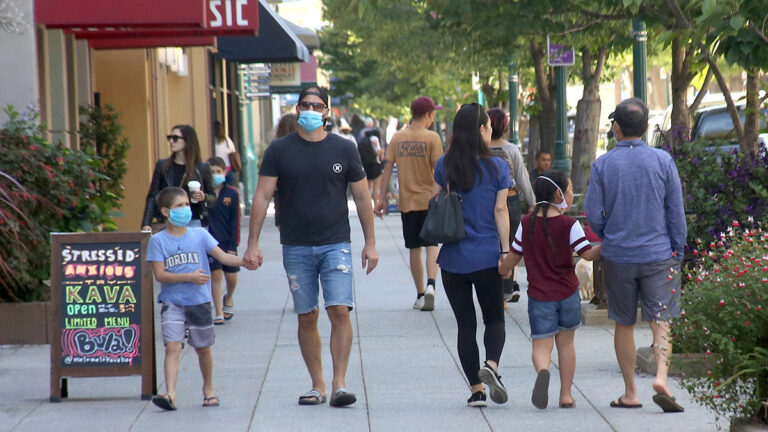
Almost Everything’s Open, But Don’t Hang Out With Your Friends

As of Friday, residents of Santa Cruz County and many other areas of California may go out to the movies or to a bar for a drink.

But with the county still reeling from the Covid-19 pandemic, county residents may not invite a guest over to their home for a movie or a drink—at least not without violating health orders from Gov. Gavin Newsom and Santa Cruz County Public Health Officer Dr. Gail Newel.

There are now plenty of other things to do. Locals have been able to go out to eat at some restaurants since the beginning of June. Retail shopping and churches reopened last month. Hotels, swimming pools, gyms, and campgrounds are all reopening today—provided that business owners and operators can implement guidelines laid out by the state.

But mingling isn’t allowed.

“Gatherings are still not permitted outside of the household, even if it’s you and a friend, and that’s a governor guidance,” Newel said in a press conference Thursday.

Newel said that if anyone does meet up with someone outside of their household, they should practice social distancing measures.

“It’s safer to be outdoors, safer to stay six feet apart, safer to wear face coverings when you’re together, safer not to share food or drink because that means removing your face covering,” Newel continued. “Those are some of the guidelines to make time outside of your household unit safer.” 

There have been 249 known Covid-19 cases in Santa Cruz County, according to information last updated by county health officials Wednesday night. Two people in the county have died from Covid-19, 34 have required hospitalization, and 197 have recovered. Statewide as of Wednesday, there have been 139,281 Covid-19 cases and 4,881 deaths, according to the California Department of Public Health

In Santa Cruz County, the number of South County cases continues to climb, as does the county’s share of patients who are Latino. That racial inequity mirrors trends seen around the state and across the nation, with Covid-19 disproportionately hurting people of color. Newel attributes that troubling trend to a pre-existing racial wealth gap and to various social determinants of health, like lack of healthcare access, lack of access to healthy foods and poverty.

Deputy Public Health Officer Dr. David Ghilarducci added that people of color are more likely to be essential workers, thus making them more likely to get exposed to the virus.

Newel and Health Services Agency (HSA) Director Mimi Hall continue to worry that the pace of reopenings could lead to more sickness. But Newel still stops short of calling for stricter guidelines than the ones issued by the state of California. For the previous two weeks, it had been unclear why Newel was expressing doubt about the pace at which changes were happening while simultaneously allowing more uses to resume in the county.

Newel said Thursday that she’s been getting pressure to quickly reopen from the public, but not from county leadership.

“I want to be very clear that the county leadership—the county administrative officer and Board of Supervisors—have been extremely supportive of me and of all of our efforts in public health and the Health Services Agency,” Newel said. “I have received no pressure from them to reopen at all. I have heard loudly from the community voices—through town halls, from my emails and phone calls and through the Economic Recovery Council, the industry leaders with whom I work—the importance of reopening the economy, and I agree with them. As I’ve said before, the reality of death by poverty is very much a real thing. People die because they don’t have adequate housing and food and other things that poverty puts them at risk for.”

Newel also left open the possibility of shutting economic sectors back down again if new outbreaks get out of hand. In terms of a statewide strategy, that approach is not on the table for California officials, according to the Los Angeles Times, which reported that Newsom is not interested in moving backward toward tighter restrictions, even as cases inevitably climb.

After Thursday’s press conference, county spokesperson Jason Hoppin sent out an email that the county HSA would no longer continue its weekly press conferences, which for the most part have been held every Thursday morning since the start of April. Going forward, he wrote, the county will hold pressers on an “as needed” basis.

Since the previous press conference, held two weeks prior, the nation saw increased protests against police violence and racism. Newel opened up her comments Thursday by telling reporters that racism poses its own public health threats.

“Racism is a public health matter, as much as Covid-19 is a public health matter,” Newel said. “And we are committed to addressing that in our community, in our public health system, in our Health Services Agency and at the county level. We’ve been working hard at an equitable approach to our response to Covid-19.”

She added that the HSA has incorporated equity into its decisionmaking in its Covid-19 response.

“We will continue to work at this,” she said.

Local Organizations Celebrate Pride Amid Pandemic, Protests

On the morning of June 28, 1969, a group of police officers raided the Stonewall Inn, a gay club in Greenwich Village, New York City. As police dragged patrons and staff out of the bar, residents responded, leading to a week of protests and violent confrontations.

The Stonewall Riots have been credited as the catalyst for the gay rights movement in the United States. The first Pride was held in 1970 in commemoration of the uprising. Gradually, cities across the U.S. began to hold their own events. 

In 1975, the first-ever Pride was held in Santa Cruz. Organized by Cabrillo College’s Lesbian and Gay Men’s Union, it is the third-oldest such event in California after San Francisco and Los Angeles. Now, 45 years later, thousands of people flock to downtown Santa Cruz for the event every year.

But with the ongoing Covid-19 crisis and subsequent shelter-in-place orders this year, the Santa Cruz Pride organization’s 2020 parade—usually held the first weekend of June—was canceled. However, that did not stop local LGBT+ groups from celebrating. Santa Cruz Pride instead held a virtual parade dubbed “Nothing Can Stop Our Pride.” People submitted photos and videos and tuned in to a large Zoom gathering Sunday.

“It was incredible,” said Sharon Papo, executive director of Diversity Center Santa Cruz County. “It was a powerful gathering of the community, coming together virtually to celebrate Pride and its history.”

The connection between Pride and the Black Lives Matter movement was not lost on participants, as many spoke about the ongoing protests in response to the killing of George Floyd by Minneapolis police.

“The Stonewall Riots were led by Black trans women,” Papo said. “They have always been our leaders. Black Lives Matter is not a separate movement because of that. We have to honor that intersection.”

Pajaro Valley Pride President Jorge Guillén had similar thoughts.

“It is so important to understand that Pride began as a riot,” he said It began as queer people fighting against police brutality.”

Pajaro Valley Pride held its first event in 2016. While this year’s gathering has also been canceled due to Covid-19, the organization has been working closely with Santa Cruz Pride, Salinas Valley Pride and Monterey Peninsula Pride to organize a virtual event. Guillén said they hope to hold it in late July or early August. 

“We weren’t really sure anything was going to happen,” he said. “But then Dina [Izzo] from Santa Cruz Pride approached us, and we began a conversation.”

Papo said that the Diversity Center has been making a “big pivot” in the past few months to move all of its support programs online. A big reason for this, she says, is that the LGBT+ community is “disproportionately at risk” from Covid-19.

“We are more likely to have diseases such as cancer, AIDS and respiratory illnesses,” she said. “We’re more likely to live in poverty. Many are essential workers and do not have access to proper healthcare.”

Guillén said that Pajaro Valley Pride is also doing what it can to keep in touch with residents.

“This is a really challenging time,” Guillén said. “On top of Covid, the issue of racism, and everything else going on … it’s overwhelming. I think that’s why it’s important to stay connected [and] support each other. We’ll get through this.”

For information about ongoing events, programs and services that support the local LGBT+ community visit diversitycenter.org and pajarovalleypride.org.

Students Can Get Two Meals a Day at School Through July

On top of implementing distance learning, school districts have been wrestling with a variety of challenges during the Covid-19 pandemic and the resulting shutdowns. 

Many schools around the country have stepped up and have practically turned into food banks for families in need. In Santa Cruz County, school district officials have announced that free breakfasts and lunches will be available for pickup to all children throughout the summer via the new Summer Meals Program.

During a typical summer vacation, children lose access to free and reduced-priced meals that they relied on during the school year, but the Summer Meals Program provides breakfasts and lunches to anyone 18 or younger. Families do not need to meet any eligibility requirements.  

There are 25 grab-and-go-style food distribution sites throughout the county. Families with children who are interested in picking up free meals may use the following instructions:

Step 1: Text message “FOOD” (or “COMIDA” for Spanish instructions) to 877-877 or call 211 for a location near you.  

Step 2: Wait for a text message back, and reply with your address.

Step 3: You will receive a text with a list of the three closest meal distribution sites, with information about each site and how to proceed to pick up meals.

Pajaro Valley Unified School District—the county’s largest school district—has 10 pickup sites. Meal distributions have been on hold this week, but they’ll continue next week and run through July 24. (Pajaro Valley Unified spokesperson Alicia Jimenez says the district needed the extra week to organize the summer feeding and staffing schedules.) Santa Cruz City Schools—the county’s second-largest district—has three pickup sites. Its distributions have continued this week, and they’ll run through July 31.

The need for healthy food across the U.S. is especially high right now, according to recent research, including a Northwestern University study, which found that food insecurity doubled in April and tripled in households with children.

Santa Cruz County nonprofits that distribute food saw steep increases in demand for their services after the pandemic started. Earlier this week, Santa Cruz County’s Great Plates Delivered program got an extension through July 10, just before it was set to expire.

Second Harvest Food Bank is doing food pickups from the Beach Boardwalk and the Santa Cruz County Fairgrounds, Grey Bears is delivering groceries to the elderly, and Meals on Wheels is delivering daily meals to seniors age 60 and over and people with disabilities.

For more information on offerings from those nonprofits, visit thefoodbank.org, greybears.org and communitybridges.org.

Artists Organize Ribbon Installation to Express Community Grief

0

In the winter of 2005, the famous Bulgarian conceptual artist Christo erected a series of curtained structures throughout New York City’s Central Park in an installation he called “The Gates.”

Christo died on May 31 at the age of 84, and so he was on the mind of Santa Cruz artist and activist Sara Friedlander when she and her cohorts in ARRT (Artists Respond and Resist Together) were looking for a way to symbolically express grief, the predominant theme of the year 2020.

The color of Christo’s large-scale art installation had struck Friedlander. It was saffron, a lush shade that exists in the spectrum between yellow and orange. Saffron has deep symbolic power in Hinduism and Buddhism.

So, the activists of ARRT are calling on Santa Cruzans to borrow a page from the yellow-ribbon playbook and tie a saffron-colored ribbon or cloth to a prominent spot outside their homes as a sign of community remembrance.

The idea came about in late May when the organization was looking for a way to mark the milestone of 100,000 Americans dead from Covid-19. While they were deliberating, American streets erupted with protests against police violence.

“And, then we thought, can we even talk about Covid with all this other grief going on?” says Friedlander. “That was when someone came up with the idea to express mourning, doing like the yellow ribbons.”

Yellow ribbons were originally used to express hope and solidarity with American hostages held in Iran in 1980, and the imagery was again appropriated during the first Gulf War in the early 1990s. ARRT’s idea is to express mourning using saffron ribbons or cloth and the names of someone who has died in the Covid-19 pandemic, or someone who has died at the hand of police, or the name of of Sgt. Damon Gutzwiller, the Santa Cruz County’s sheriff’s deputy killed in the line of duty on June 6.

“We thought this would be a marvelous way to bring the community together in our grief and our sense of protest,” says Friedlander.

It’s important that symbolic expressions have artistic cohesion, says Friedlander. “If you have a uniform color and a uniform sensibility, then people can really pay attention to what the message is. The idea is that it can be beautiful as well as catching people’s attention.”

Saffron ribbon and cloth isn’t easy to find, says Friedlander, but it’s available online, or white fabric can be dyed with turmeric. “What we’re asking people to do given that we’re all still relatively house-bound is to post images on Instagram.”

Saffron, says Friedlander, is “uplifting but solemn at the same time. Because I’ve been to Thailand and I’ve seen Buddhist monks in robes of that color, it’s always very touching and moving to me.”

Fundraiser for Slain Sheriff’s Deputy Raises More Than $450k

0

The Peace Officers Research Association of California has established a fundraiser for the family of Sgt. Damon Gutzwiller, the Santa Cruz County Sheriff’s Deputy who was shot and killed in the line of duty Saturday in Ben Lomond.

The account has collected more than $450,000 for the Gutzwiller family as of today. The current goal is to reach $600,000. To donate, click here.

Gutzwiller, 38, left behind a 2-year-old son and a wife who is three weeks away from delivering their second child.

“Our law enforcement community is in mourning and is asking for your donations for the family,” the fundraiser website states. “No amount of monies will make this tragedy right, but it will allow the people Damon cared about most to continue their lives without thoughts of financial issues. All monies donated will go directly to his family.”

Gutzwiller first joined the Sheriff’s Office in 2006. Sheriff Jim Hart has called Gutzwiller a “true hero.”

“In this era that we’re in, what you want to see in a police officer—compassion, caring, someone who truly loves his job, who wants to help people—that’s what Damon was,” Hart said.

Community Calls for Watsonville’s City Council to Save Sports Programs

The city of Watsonville will have to make several tough cuts to meet a projected $6.5 million budget deficit for the upcoming fiscal year. 

But more than two dozen community members defending the value of youth sports programs at Tuesday’s virtual City Council meeting urged the council to not balance its budget on the backs of young people. Instead, they asked the council to trim from other departments to keep the city’s recreational and competitive soccer programs running.

In its draft budget presented Tuesday, the city proposed a $3 million cut to salaries and benefits. It is also trying to save $1.3 million by trimming its discretionary spending and dipping into its Measure Y and cannabis tax funds.

Staff is asking the council to use half of its $4.4 million emergency fund balance to make up for the massive drop in revenue as a result of the shelter-in-place restrictions put in place to slow the spread of the novel coronavirus.

Included in those cuts is the city’s entire sports program budget and five employees, three of which work for the Parks and Community Services (PCS) department.

The city said it is cutting youth sports because those programs are currently—and, they believe, will continue to be—prohibited because of the physical distancing and shelter-in-place restrictions. But community members assert that the state and county are loosening restrictions quicker than expected and that it would be shortsighted for the council to cut those programs for the rest of the fiscal year.

Those community members were also frustrated that parks and youth programs were again bearing the brunt of the budget cuts. 

“If we don’t have money for kids,” Carlos Campos wrote in an email read to the council, “what are we saying about our future?”

The council is expected to finalize the budget at its June 23 meeting, but much could change in the days leading up to that date. 

Gov. Gavin Newsom and state health officials have picked up the pace at which they are moving through their “Resilience Roadmap,” allowing movie theaters, gyms and bars to reopen starting this weekend.

At the federal level, the HEROES Act has proposed $375 billion to help local governments repair their shredded budgets. That bill, however, has stalled after being passed in the Senate, and faces opposition from many Republican lawmakers.

Because of that volatility, Watsonville Finance Department Director Cindy Czerwin said she will provide the council quarterly updates, and ask for changes as they are needed. Her first update will come in late August when the city will have a clearer picture of its property and sales tax numbers. She will then return in November and again in February, though she did say she was willing to provide reports to the council with more regularity.

“We’re going to have to be amazingly flexible,” Czerwin said.

The city received two dozen emails, and another dozen people called into the meeting to voice their support of the youth sports programs. Many said they grew up playing sports through the city’s programs, and a handful of kids wrote emails to the council asking them to keep the programs funded.

Watsonville Recreation Coordinator Jenny Vivenzi, who is one of three PCS employees on the chopping block, called into the meeting to advocate for the programs and also coordinated calls with a trio of volunteer soccer coaches.

Most of those comments did little to sway the council, as the majority of councilmembers said the decision was out of their hands because of the Covid-19 restrictions.

Councilwoman Trina Coffman-Gomez was the lone councilmember who asked staff to look for funding for the programs elsewhere, suggesting they trim the council’s benefits even further than their already proposed 50% cut.

Czerwin and City Manager Matt Huffaker during the meeting said they received late word that the Pajaro Valley Community Health Trust would help fund some of the programs if the city did indeed follow through with the proposed cuts.

The majority of next year’s projected deficit is a result of the countywide shelter-in-place restrictions. The city’s sales tax—21% of the general fund’s yearly revenue—is expected to be down 26.3%.

Along with the five aforementioned layoffs, the city also plans to reassign two employees to other positions. Other employees have agreed to take one day off per month without pay through the end of the calendar year, and the city also saved $1.3 million by eliminating roughly 27 vacant positions.

California Union Leaders, Politicians Call for Tax Hikes, Not Budget Cuts

Due to dramatic losses suffered during the Covid-19 pandemic, California is facing a $54 million budget shortfall, and steep cuts are likely coming to state and local budgets.

A coalition led by the Service Employees International Union (SEIU) is pushing for politicians to prioritize equity, instead of slashing away at social safety nets. Union leaders outlined their vision in a letter to state legislators, and 55 organizations signed on.

“This movement says, ‘All of us together, we refuse to cut our way out of this crisis on the backs of communities of color,’” Rico Mendez, chief elected officer for SEIU Local 521, said Wednesday on a Zoom call with other union leaders and with politicians. “Our elected leaders must pass a recovery budget for all … That means not going back to status quo, because that won’t be good enough. We need to make equity our new normal.”

In the midst of a Covid-19 pandemic that is disproportionately harming Hispanic and black Americans, union leaders like Mendez say the state’s proposed social safety net cuts—such as $450 million in cuts to In-Home Supportive Services, and billions of dollars worth of cuts to education—would worsen California’s income and racial disparities.

Gov. Gavin Newsom’s proposed budget outlines what are known as “trigger cuts”—cuts that will take effect unless California gets additional financial support from the federal government. Mendez said that California should not leave its fate in the hands of Senate Republicans and President Donald Trump, especially after U.S. Senate Majority Leader Mitch McConnell (R-Kentucky) suggested that states having a hard time paying their bills might pursue bankruptcy as an option.

“The truth is trigger cuts are still cuts. They would hurt black Californians more than any other group if they’re enacted,” Mendez says. “The truth is enacting a budget with trigger cuts means leaving the future of racial justice in our state up to someone like Mitch McConnell and his Senate—that have made it clear that they have no intention of supporting California at the levels necessary. The truth is that we can do better. Our state is the fifth-largest economy on the planet. We can raise the funds that we need to go forward.”

Politicians like Ash Kalra (D-San Jose) and Santa Clara County Board of Supervisors President Cindy Chavez have signed on to the effort and spoke to union representatives Wednesday to offer encouragement and support for a shared vision. “We need to invest in housing, in our health systems, in childcare,” Kalra said.

But in order to preserve programs and still balance its budget, the state will need to either find savings somewhere else or create new sources of cash flow.

A budget is a moral document, said Eddie Carmona, director of legislative organizing for PICO California, the largest multi-racial faith-based community-organizing network in the state of California. In order to secure more revenue, he called on leaders to raise taxes, create new taxes, reform commercial property taxes and look at the state’s ability to borrow from special funds and bonds.

In short, Carmona called for a “California New Deal.”

“We need to not only address the inequities that were uncovered by Covid-19,” he said, “but need to double-down and invest in the future of California, a future of California that’s going to be built by and for working families and for communities of color.”

Police Investigate Suspicious Object on Santa Cruz Westside

UPDATED, 3:30pm: Santa Cruz police posted on all clear shortly after 3pm Wednesday.

They wrote in a tweet that officers determined the suspicious object found on the Westside of Santa Cruz did not pose a threat.


Santa Cruz police are investigating a “suspicious object” that was found on the Westside of Santa Cruz Wednesday afternoon, forcing the closure of several roads and a shelter-in-place order for some residents.

Police have teamed up with the Santa Cruz County Sheriff’s bomb team at the corner of West Cliff Drive at Bay Street. The bomb team deployed “Sparky,” the robot designed to handle dangerous objects.

A witness reported a suspicious cylinder-shaped object lying beside the popular pedestrian and bike path just before 1pm.

Authorities have closed West Cliff Drive and part of Pacific Avenue, as well as Bay and Front streets.

As of 1:35pm the incident was ongoing.

Anatum Winery’s Bold Pinot Noir; Plus Wine Gift Ideas for Father’s Day

Some Anatum wine was left for me at the Good Times office on Dakota Street in downtown Santa Cruz. I contacted Chris Broaddus, owner and winemaker at Anatum, to thank him—only to find out he didn’t leave it. Probably an Anatum wine enthusiast out there wanted me to try Anatum’s Pinot Noir.

After chatting with Broaddus, I was all set to do a tasting of his wines at one of Shadowbrook’s Wine Wednesdays, but it was cancelled because of the shelter-in-place order. I’m looking forward to going to Anatum’s tasting room—when it’s open to the public again—to try the rest of their wines. They also make Chardonnay, Trousseau, and a pinkish-amber Pinot Gris that makes you think of Strawberry Fields Forever.

This estate 2017 Pinot Noir ($22) is from organically grown grapes individually tended to with the utmost care. “On the spectrum,” says Broaddus, “this Pinot Noir is on the bigger, bolder end.” Fruity flavors of plum, stone fruit, cigar, and berries, make this food-friendly Pinot Noir a tasty pairing with just about any food. A stir-fry I made with rice, bok choy and other veggies was a wonderful match-up with this bold and delicious Pinot.

Anatum Winery, 375 Falcon View Terrace, Watsonville. 831-430-6123. Anatumwines.com.

Wine for Father’s Day

Father’s Day is on June 21, so there’s plenty of time to get your pater some good local wine. Also, there are many wine-related events going on during the shelter-in-place order, including virtual tastings on Sundays. Visit the Santa Cruz Mountains Winegrowers Association website for more info on this, and check out their new PremierPass wine-tasting experience as well.

Scmwa.com. 

Gift certificates for wine tastings make a great gift, and quite a few wineries are now doing their own merchandise. Stockwell Cellars has some cool swag like hoodies and T-shirts, and the winery owner of MJA Vineyards (Marin Artukovich) grows coffee in Kona, Hawaii, and sells it in his tasting room on the Westside. And who doesn’t love Champagne—aka sparkling wine! Head to Equinox Wines, also on the Westside—they make the best.

Pajaro Valley Arts’ Annual Outdoor Exhibit Takes Shape

Exhibit will return to Sierra Azul Nursery and Gardens on July 1

Almost Everything’s Open, But Don’t Hang Out With Your Friends

Mingling with those outside your household still verboten

Local Organizations Celebrate Pride Amid Pandemic, Protests

Pride celebrations went virtual amid the pandemic

Students Can Get Two Meals a Day at School Through July

There are 25 Santa Cruz County pickup for families

Artists Organize Ribbon Installation to Express Community Grief

Activists call for Santa Cruzans to tie a saffron-colored ribbon to a spot outside their homes

Fundraiser for Slain Sheriff’s Deputy Raises More Than $450k

All proceeds will go to family of Sgt. Damon Gutzwiller

Community Calls for Watsonville’s City Council to Save Sports Programs

Watsonville faces tough cuts with projected $6.5 million budget deficit

California Union Leaders, Politicians Call for Tax Hikes, Not Budget Cuts

Labor responds to Gov. Gavin Newsom’s trigger cuts

Police Investigate Suspicious Object on Santa Cruz Westside

Police closed several roads and issued a shelter-in-place order for nearby residents

Anatum Winery’s Bold Pinot Noir; Plus Wine Gift Ideas for Father’s Day

Gift certificates for wine tastings make a great gift
17,623FansLike
8,845FollowersFollow